2025-07-17
2026 UX Design Trending
YAHA Lab
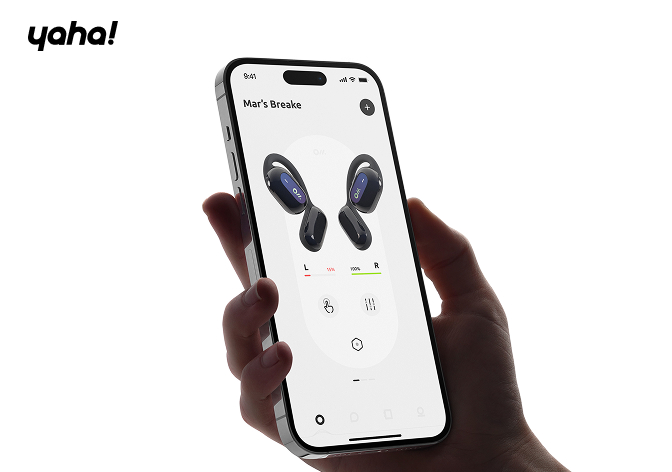
Minimalism
The core of minimalism lies in precisely eliminating unnecessary elements to enhance the communication of functions and intentions. Each component must have a clear purpose for interaction or information transmission to reduce the user's cognitive load, enhance operational efficiency and immersion. Research has confirmed that users can form an interface impression within 50 milliseconds, and overly complex designs will directly lead to churn. Minimalism achieves a balance between aesthetics and functionality through white space management, element focus, and progressive information presentation.

The image is quoted from: https://dribbble.com/glebich
AI - driven design
Artificial intelligence is reshaping the design workflow, shifting from the execution level to strategic collaboration. AI tools can efficiently generate layout, color matching and brand system solutions, freeing designers to focus on creativity and contextualized decision-making. The key advantages are reflected in: rapid iteration capability (generating multiple solutions within minutes), human-machine collaboration mode (designers act as instruction planners and output calibrators), and the expansion of high-level innovation space (such as personalized experience design). The combination of human intuition and machine efficiency will become the core competitiveness.

The image is quoted from: https://dribbble.com/glebich
Multimodal voice interaction
The voice interface has evolved from mechanical command response to a natural context dialogue system. Its value lies in seamlessly integrating visual and auditory feedback to build efficient interaction in scenarios where hands are liberated. The core breakthrough lies in the maturity of natural language processing (NLP) technology, which supports emotional timbre and multi-round context understanding. The design focus shifts to the coherence of cross-channel experiences: voice input must be accompanied by real-time visual confirmation to avoid cognitive gaps while strictly ensuring the controllability of privacy.
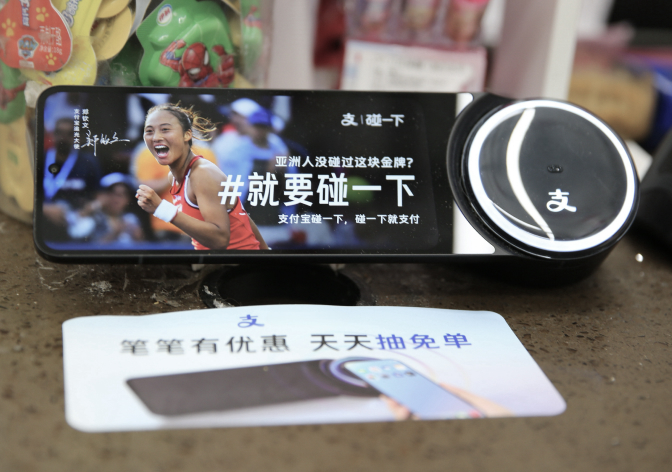
The image is quoted from web
Zero UI
Interaction design is moving away from screen dependence and towards environmental perception and predictive services. Through Internet of Things sensors, computer vision and behavioral data analysis, the system actively responds to user demands (such as automatic replenishment and environmental adjustment). The design challenge lies in establishing an invisible yet reliable feedback mechanism (such as tactile/acoustic cues) and addressing ethical and trust issues (data transparency and user control rights). The essence is a paradigm shift from "operation interface" to "seamless service".
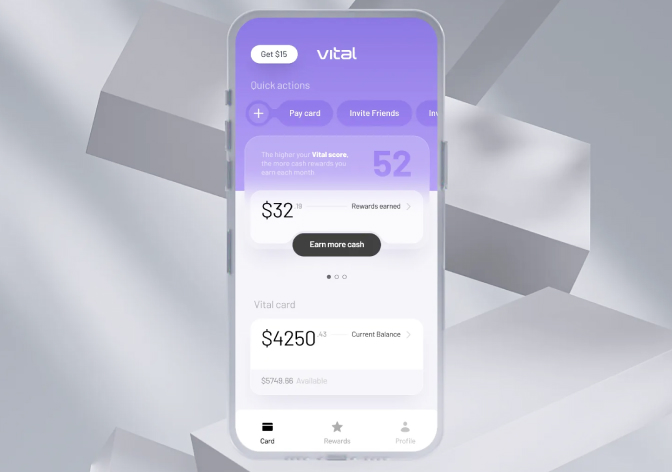
The image is quoted from: https://dribbble.com/shots/22464658-Vital-purple-UI-for-banking-iOS-app-by-milkinside
Soft Neumorphism
The new mimicry has evolved into a 3D suggestive style that strikes a balance between aesthetics and accessibility, shaping tactile realism through subtle shadows and highlights while ensuring that color contrast meets WCAG standards. Its advantage lies in taking advantage of human cognitive instincts towards physical objects to reduce the cost of learning. Key implementation principles: Local application (only key interaction elements), combination with flat design to form layers, and dynamic feedback (such as button pressure sensing simulation) to enhance operational determinism.
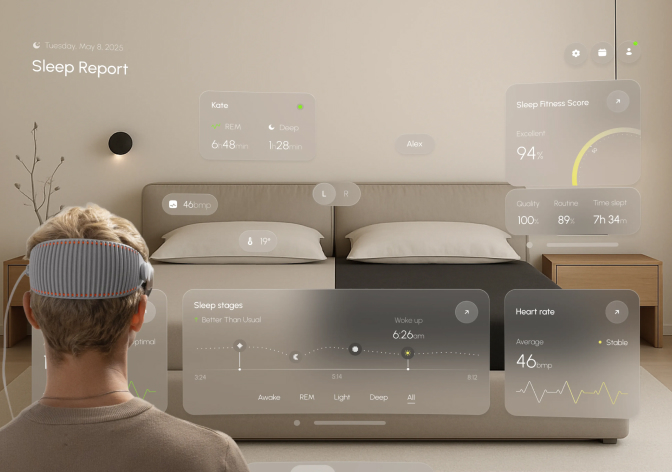
The image is quoted from: https://dribbble.com/RonDesignLab
空间化3D设计
随着AR/VR设备普及,界面设计从二维平面转向三维空间叙事。3D元素通过景深、透视与物理运动模拟增强信息层级表现,显著提升用户参与度与数据理解效率(如三维数据可视化)。设计需遵循空间认知规律:近域元素优先聚焦,运动轨迹符合现实物理预期,且必须优先保障性能流畅性以避免晕动症。

© Copyright 2020-2025 YAHA Design Co.
-
Tel.
-
MAIL
-
ADR.深圳市龙华区设计产业园总部大厦1号楼1006
-
SNS.
Behance
Zcool
Redbook
WeChat


© Copyright 2020-2025 YAHA Design Co.